Wednesday, February 07, 2007

LOST: Philadelphia Weekly Feb 7, 2007


Watching Lost is like befriending the new girl in school. It all began so well.
When Lost moved into the neighborhood in the fall of '04, you were the first to get to know her. Unlike other shows you'd seen before, she was willing to delve into her past with endless detail—via flashback, of course. She talked openly about her problems with dad (Jack), the trouble with boys (Kate) and how she loved to get high (Charlie). There were episodes when seemingly nothing happened, but that was good, right? When you were with Lost, time stood still.
And then that got old. The boar begat the mysterious smoke, which begat the polar bear, which begat the French lady, which begat the “Others,” which begat the hatch, which begat the numbers, which got boring. Or frustrating, at least. So what went wrong?
Like the new girl in school, Lost was bound to make friends. As her popularity and ratings soared, she made friends who had money (advertisers) and friends who wanted to make more of it (ABC, presumably). Any time we got close to an answer, lost teased and turned. It extended without explaining. Were Hurley and Libby both in the same mental institution? Bam! She's shot by Michael. Was Shannon really seeing Walt? Bam! Shot by Ana-Lucia. Did Mr. Eko know more than he was letting on? Bam! Killed by a monster.
Which brings us to today, the return of the third season after a scant six episodes last fall. Jack holds the fate of Ben's life in his surgical hands while Kate and Sawyer plan their escape to and from an island.
It's taboo to reveal too much of what'll happen, but the wait is worthwhile. Maybe the expectation of learning nothing new has altered the viewing experience, but the plot moves. People make decisions. We see the results. In a moment of levity we learn the name of that guy with the fake beard.
But this could all be a ruse. Next week we could be treated to an expose on Locke's sudoku obsession. Or maybe the tide is shifting. It's possible Lost's producers began to feel a bit too Keyser Söze-like in all the misdirection and deceit. It's possible they've been watching 24. And it's possible that if and when the show jumps the shark, it will involve an actual shark.

Monday, January 01, 2007

Tahiti 80 - Fosbury: MAGNET Jan/Feb '07


For one reason or another, the few French rock groups that manage to trickle over the Atlantic and into the American undercurrent share a similar pedigree. Phoenix and Air, for example, both sing in that slightly-slurred, mostly charming Frenglish (if they choose to sing at all). Not to mention their obsession with glitzy, Jamiroquai-esque pop. Tahiti 80 doesn't attempt to brak away from the pack, but that’s more of an observation than a complaint. The Paris group's third album is a midnight rave. Anyone familiar with the Neptunes’ patented production will find warmth in Fosbury's crisp, clanging songs. Not coincidentally, vocalist Xavier Boyer and bassist Pedro Resende, who formed Tahiti 80 in 1993, hired Neptunes’ colleagues Neal Pouge and Serban Ghenea for production and mixing. “Here Comes…” steals the hook from Snoop Dogg’s “Beautiful,” keeping the bodies moving while Boyer meditates on redemption and regret. “Changes” covers the same lyrical terrain ("Changes are happening, it's too late to turn back"), burying the emotion in a frantic, Indian-inspired beat. Call it a gift or a curse, but it's difficult to uncover Boyer's demons when the party won't stop.

Bon Savants: MAGNET Jan/Feb '07


Thom Moran feels like a born-again musician. After recovering from a near-fatal stab wound suffered during a mugging in Boston seven years ago, he began to grasp his life’s ambition.
“There’s something to the stereotype of near-death experiences really putting into focus how short life is,” says the 30-year-old Bon Savants singer/guitarist. “You can either do a lot of things OK or a few number of things really well. I finished school and decided I’m gonna play music.”
Moran and Bon Savants co-founder/guitarist Kevin Haley met as teenagers in Frankfurt, Germany. A stint in the Air Force had Moran stationed abroad, while Haley was a military brat looking to start a band. The two bonded over Pavement and Pulp, then formed a post-punk group called W.H.Y.
“Most rehearsals,” laughs Moran, “we just tried to see how close we could get to being Fugazi.”
Fast forward to 2003: Moran is coordinating sub-orbital rocket tests at the Massachusetts Institute of Technology. Haley is bouncing around Texas and Colorado until Moran convinces him to move to Boston. A Craigslist post corrals bassist Dave Wessel, and the trio recruits Berklee-educated drummer Andrew Dole by way of another Internet post, reading: “Need a drummer to play Middle East (a Cambridge, Mass., venue) covering Pulp. I can’t believe we haven’t found somebody to do this already.”
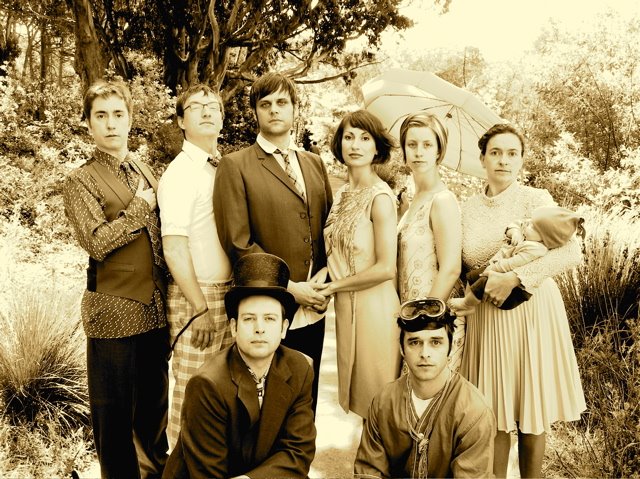
Bon Savants are born shortly thereafter, recording Post Rock Defends The Nation on ProTools and sending the disc to Bill Racine (Rogue Wave, Mercury Rev) for mixing. The self-released debut embodies Moran’s second-chance sentiments. On album opener “What We Need,” Moran laments the one who got away in his best Stephin Merritt baritone. He revisits his brush with the Reaper on the title track, proclaiming, “I bled to death on a neighbor’s lawn.” Little else on Post Rock Defends The Nation is as morbid, but there’s a level of obliqueness heightened by peculiar phrases (“Oh, you kiss like a Russian,” “I am the atom bomb”) coupled with images drawn from Moran’s scientific background (“Feel a charge in your matter like an electrical storm”).
The band members’ Pulp fascination figures into Post Rock Defends The Nation, as does Haley’s resounding, Interpol-esque guitar work. As fate would have it, Haley—responsible for co-writing many of the album's 11 tracks—recently left the band under amicable terms. (He was replaced temporarily by guitarist Bek Zaganjori; guitarist Craig Hendrix and keyboardist Brian Hamilton have since joined Bon Savants.)
“You don’t want to try what you did before,” says Moran concerning Haley’s departure. “It’s never gonna be as good as it was that way, but maybe better in a different way.”

Tuesday, September 19, 2006

Michael Zapruder's Rain Of Frogs: MAGNET Oct/Nov '06


If at first you don’t succeed, try again every seven days. In 1999, Michael Zapruder began writing, recording and posting a new song online each week for a year. The results can be found at www.52songs.org, but the rewards are vast and varied. Listening to the Oakland, Calif., musician’s sophomore album, New Ways Of Letting Go (Howells Transmitter), is akin to hearing Rufus Wainwright croon over Andrew Bird’s simmering string arrangements. But Zapruder wasn’t always blessed with perfect pipes.
“Well, it’s funny,” he says. “I didn’t make my school chorus when I was a kid, and I was the guitar player for bands for a while. I remember I started to sing songs and people would come up to me and be like, ‘Hey man, you know your guitar playing is really good, but the singing is just … You know, don’t sing.’”
A bit of practice was all Zapruder needed, and by the end of his 52-song project, he had developed his smooth, silky delivery. People soon took notice. Nate Query (the Decemberists), Jonathan Segel (Camper Van Beethoven), Scott Solter (John Vanderslice) and more than a dozen other musicians make up the Rain Of Frogs, Zapruder’s carefully chosen backing band.
Zapruder’s orchestral compositions are complex but not overbearing (he studied music at Oakland’s Laney College), allowing for each Frog to hold its own without disrupting the balance of strings, piano and the occasional triangle or shaker. Surprisingly, the Rain Of Frogs network has no roots in Laney College, sprouting instead from various connections Zapruder made through friends or Pandora.com, where he’s the music curator.
“I think I’m surrounded by talented friends,” he says. “I thought it would be interesting and fun and would make a better record to open the door and say, ‘Anybody I know might be in this band.’ I mean, if you play anything and have good ideas, you might … you know. [Laughs] I’m totally serious. It’s a lot more fun to work like this.”
Michael Zapruder - The Alchemist.mp3

The Black Neon - Arts & Crafts: MAGNET Oct/Nov '06


It's true what they say about German engineering. So when Steve Webster, the sole Brit behind the Black Neon, wanted to get truly motorik on his new album, he motored straight to Berlin. There, he honed his handiwork with members of krautrock progenitors Amon Düül and Ash Ra Tempel. Arts & Crafts is an eclectic set of party starters that's best likened to a few other westerners looking east: "Cast That Light" is Anton Newcombe breathing smoke into Air's mellower moments, and "TX81Z" is Beck covering New Order's "Blue Monday."
VIDEO: TX81Z

Staff Infection: MAGNET Oct/Nov '06


Brotherhood and Weeds
I didn’t have cable television until college. When my friends used to complain about the newest MTV VJ, I smiled and nodded. When they argued over whether Jenny McCarthy or Carmen Electra was a better/hotter Singled Out host, I shrugged. When I Google image these women today, I question my friends’ tastes. Now that I have more than five fuzzy channels, I mainly watch sports and Project Runway. But there’s also Showtime’s Sunday/Monday one-two punch. Brotherhood is tense and shocking, and it’s been described as an Irish version of The Sopranos. (To be honest, I’ve only seen a handful of episodes of that show, but I hear it’s great and I’ll agree with the comparison.) On Brotherhood, one brother is a rising Rhode Island politician, the other is a crook. Mom loves them both! On Monday nights, there’s a mom I love: Weeds’ Mary-Louise Parker. Her husband dies of a heart attack, so she deals pot to rich neighbors in order to provide for her two sons. The soundtrack kicks ass (Rogue Wave, Sufjan Stevens, New Pornographers, Mountain Goats), and Parker’s sarcastic, cool-mom delivery is priceless. I Google image her, too.

Someone Still Loves You Boris Yeltsin Broom (Polyvinyl)
What with all the clapping of the hands while saying yeah and the question of what made Milwaukee famous, band nomenclature has lost some of its restraint. But that’s no reason to dismiss Springfield, Mo.’s Someone Still Loves You Boris Yeltsin. In fact, the four-piece is worth its weight in syllables. Much has already been made of the band’s overt Shins similarities, and it’s a good starting point; “I Am Warm & Powerful” will certainly hold you over until January, when the Shins’ third record is finally released. Two-thirds of the Unicorns might have gone on to form Islands, but the former band lives on in the playful, morose nature of “Anna Lee.” The elephant in the room would be labelmate Of Montreal, whose giddy stylings drive the opening track “Pangea.” Oh, and speaking of that Athens band, its “Wraith Pinned To The Mist And Other Games” just happened to close out an episode of Weeds.
SSLYBY - Oregon Girl

Monday, September 18, 2006

Antlerand: MAGNET Oct/Nov '06


When it comes to categorizing, Antlerand has critics reaching for hyphens and modifiers. "Emo-core," "psychedelic rock" and "atmospheric trance" are just a few of the genre tags tossed at the Portland, Ore., trio since its formation four years ago, but Antlerand finds little solace in locating a musical niche.
"Those lines of demarcation aren't always useful, helpful or accurate," says multi-instrumentalist Zach Okun. "Doesn't the average listener listen to a wide variety of sounds? The point being, why is it weird that bands are all over the map?"
Appropriately, Antlerand was conceived at different points on the geographic map, starting as a long-distance collaboration between Oregon and Arizona. Okun was studying sound recording in Phoenix when a mutual friend connected him with Chris Larson, a Portland guitarist/vocalist who was busy incorporating visual projections into live performance. The duo debuted as Invisible, releasing The Invisible EP in 2004. By that time, Okun had moved to Portland, and the pair picked up drummer Delaney Kelly after spotting him perform alongside his girlfriend's modern-dance routine.
Invisible morphed into Antlerand after Kelly's inclusion, but the group is far from putting on its last picture show. When played live, each song is carefully synchronized with screen images consisting of lines, geometric shapes, people and places. All this might seem like an art-school vanity project, but it did draw the attention of Sleater-Kinney/Quasi drummer Janet Weiss, whom Okum met shortly after moving to Portland. How she came to guest on Antlerand's recent Branches (Sound Family) is a case of life imitating art.
"We would joke about how that last part of the song ("Now It's A Year") was kinda like a Quasi song," says Okun. "And it just seemed fitting that we'd have Janet come sing on that one."
Weiss' contribution is more cameo than showcase, as her singing almost falls through the mix. This is common for Antlerand, which sometimes employs vocals as a texture instead of a soapbox. "Now It's A Year" opens with Larson's lucid voice over heavy-handed piano chords, followed by Postal Service-esque clicking and Kelly's potent, sparse drumming. Larson and Weiss would sound like Mates Of State at the chorus if not for the droning instrumentation behind them. Branches brims with subtlety, whether it's the slight graces of glockenspiel, accordion and bells, or the discordant Modest Mouse horns at the climax of "Brighter Rays."
"I really like the fact that some songs, although they're primarily rock-based instrumentation, all of a sudden a banjo comes out of left field," says Larson. "I really like that kind of unexpectedness; kinda trying to wiggle out of being easily defined."
Antlerand - Now It's A Year.mp3
Antlerand - Brighter Rays.mp3

Now It's Overhead - Dark Light Daybreak: MAGNET Oct/Nov '06


Not even Michael Stipe’s endorsement could make Now It’s Overhead the next R.E.M. (Stipe contributed vocals to NIO’s 2004 album Fall Back Open.) But since both groups sprouted out of Athens, Ga., it’s fitting that the up-and-coming quartet’s fuzzy college rock would suit nightswimmers and daytrippers alike. On Dark Light Daybreak, the group’s third record for Saddle Creek, Now It’s Overheard cuts back on its former haze to graze in cleaner pastures. For most of the album, lead singer Andy LeMaster sounds like a blend of Stipe and Richard Ashcroft, and his syrupy voice is one of the few factors driving the tick-tocking “Night Vision.” On “Walls,” he evokes Tim Kasher of labelmate Cursive, sing-yelling his way out of thick, constricting layers of guitar and a sliding bass line. Opener “Let The Sirens Rest” basks in those vibrant, echoing U2 riffs that fill stadiums with sound and people. Still, LeMaster often opposes the pop world’s strict separation of verse and chorus—not that there’s anything wrong with that—keeping Now It’s Overhead above the heads of the masses. If he wanted to heed pop formulas, he could turn his artist-approved band into more than a name overheard.
Now It's Overhead - Walls.mp3

In The Studio - The National: MAGNET Oct/Nov '06


Lightning can strike twice, even in a vacuum. Or at least that's the rationale behind the National's return to Bridgeport, Conn., where the Brooklyn quintet recorded parts of last year's critically acclaimed beast Alligator with producer Peter Katis (Mercury Rev, Interpol).
"The town we're in, there isn't a lot," says frontman Matt Berninger. "It's good to work in this cocoon way and kind of go crazy and be in that zone to find interesting things." Not only does the band rarely leave the porch of Katis' Tarquin Studios, the members work separately within the Victorian-style home before piecing together individual ideas at the end of the day.
"The band doesn't have a specific songwriter, and nobody claims any kind of ownership over the songs," says Berninger. "Sometimes it's for the worst, but we will usually find the song. We are right in the middle of the mess of finding the center of the song and the magical stuff."
Still, the National's lovelorn lyrics come from Berninger's brain, and he insists the new record, due in March on Beggars Banquet, won't have him dwelling on the depressed.
"I was obsessed with romantic awkward situations, and I still am to a certain extent," he says. "I feel like I don't need to write a song about that so much. But to be honest, there are a few songs going into that territory."
Southern-bred folkmaster Jim White is also in Connecticut, working with producers Joe Pernice and Michael Deming (Beachwood Sparks, Silver Jews) at the latter's CharterOak Studios. White is backed by members of New York City roots-rock collective Ollabelle, and the record should be ready for a March release on V2.
The National - Slipping Husband.mp3

Saturday, September 02, 2006

David Sunflower Seeds: MAGNET Staff Infection Jul/Aug 2006


My obvious opposition to monopolies aside (is there any other sunflower seed company?), David sunflower seeds might be the best snack on the planet. No, I’m no baseball player, nor am I a “seeder,” as the company’s ad campaign deems the so-called in-crowd. Nor will you find my cheeks packed like a chipmunk stowing goods in anticipation of the winter dearth. What I am is addicted, and what you will find in each roasty, toasty shell is a little taste of earth’s goodness. Overeating can result in a sore tongue (much like after chewing on a few of those pesky, amazing Sour Patch Kids), but it’s just nature’s way of reminding you to check yourself before you wreck yourself. If David wasn’t already the Goliath of the seed business, these snacks would bring the warrior down.

Smoosh - Free To Stay: MAGNET Staff Infection Jul/Aug 2006


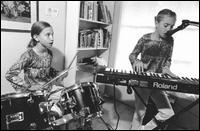
It’s disturbing—not to mention illegal—for grown men to be interested in 12- and 14-year-old girls. So slap the cuffs on me, because Smoosh has cultivated a crop of forbidden pop fruit typically reserved for bands that have at least attended and dropped out of high school. But this Seattle drum/keys duo of sisters Chloe and Asya (last name wisely withheld) hasn’t done it alone. Death Cab For Cutie’s Jason McGerr is Chloe’s drum teacher and the band’s mentor, guiding the youngsters through tours with Jimmy Eat World and Mates Of State and opening slots for Pearl Jam, Sleater-Kinney and Death Cab itself. Asya’s voice occasionally thins to reveal her age, but it’s nothing worth having a sixth-life crisis over. Her kooky, often distorted keyboard riffs easily and gleefully complement Chloe’s refined, rattling drum strikes. If the sisters were 10 years older, their music would probably be marketed with hipster-approved twee terms such as “youthful exuberance,” “unbridled enthusiasm” and “childhood innocence.” In 10 years, let’s hope the duo can still showcase these traits without a smidgen of irony.
Smoosh - Find A Way.mp3

Bye, Sophia.

Tonight is Sophie's last night in Philadelphia. She's off to bigger things (NYC, specifically). But, as they say, it's a doggy-dog world.

Sunday, August 27, 2006

Chi-hua-hua-hua, all the way home.

This is Sophie. Her hobbies include licking, spinning and jumping. She is a great proponent of the double-pawed high-five, and she curls up when she sleeps.

Wednesday, August 23, 2006

"All the girls post the same four pictures." - Nate Ruess


Saturday was Rachel Meadow's birthday. I brought a rotisserie chicken to the potluck. It was left untouched. Not pictured: Rachel Meadows

Monday, August 21, 2006

REALITY 2, KEVIN 0


I was hit with two losses last Wednesday, but that's reality for you—or reality tv, at least. Alison Kelly, my favorite Project Runway contestant, was booted after designing what can only be described as "crumpled paper mache armor." The contestants could only use materials found at a recycling center, and walking down the runway, Alison's model looked as stiff as the paper she was draped in. I thought Jeffrey's creation was the most creative (a textured blue/yellow dress with a broad belt), but even his crush on Alison wasn't enough to give him the win. I can't blame Jeffrey, as Alison appeared to be one of the few sane people on the show. According to her exit interview, the two totally hit it off when they discovered they both wore necklaces with the Eiffel Tower dangling from them. What are the chances that two fashion designers would have a love of Paris? And they, like, totally like the same movies and music, too! Michael, another one of the sane, wowed the judges with his trashbag-as-neck adornment. As for Alison: Despite her having an irritatingly unplaceable accent (she reps Boston, but it sounded half Floridian/half speech impediment), it is a shame to see her lose to a man (Vincent) who put a trash can on a woman's head and sent her down the runway. He also kept mentioning how much his dress "got him off" and "turned him on," which is all a bit creepier than his smile.

Stay tuned for thoughts on the SYTYCD season 2 finale, which came down to the awkwardly dubbed "Tranji" (Travis or Benji). I personally prefer the sound of "Benvis."

Monday, August 14, 2006

Martha Berner: MAGNET Jul/Aug 2006


Martha Berner is making up for lost time. Since leaving high school, the 29-year-old singer/songwriter has lived in locations as far-flung and exotic as Alaska, Israel, the Virgin Islands and Thailand. But you can’t blame someone for seeking a life beyond Williams Bay, Wis., a village 90 miles northwest of Chicago without a single traffic light or grocery store. Berner needed to see the world.
“I had this insane wanderlust growing up,” she says in a slight Midwestern accent that’s more Fargo than Chicago, where she now resides. “My father hasn’t flown on an airplane for 25 years and probably only once in his life.” Still, Berner defends her hometown as a great place to grow up, if only because her creative side could better flourish in the absence of big-city distractions.
Then again, abandoning small-town comforts can also foster some large-scale lessons. Look no further than the underlying theme of “A Town Called Happiness,” a rollicking, acoustic-guitar-and-harmonica-fueled track on …This Side Of Yesterday (Machine), Berner’s sophomore album. Despite her dog-eared passport, the titular burg is more a mindset than a locale.
While living in San Francisco, Berner’s car collided with a small passenger train. “It clipped me on the right corner of my car and spun me around,” she laments. “I was just sitting there in the bright, white-light sun in my totaled vehicle. It was just the idea of, ‘God, what I wouldn’t do to be anywhere but here right now.’ That’s the inspiration behind that song.”
The casual listener might not glean that message from her lyrics, which tend to bury their meaning in metaphors. In the actual song, her wreck takes the form of two hitchhikers hoping for sunnier climes. The only allusion to her own misfortune appears near the end when she sings, “And you’re still misbelieving/You didn’t see the train.”
Berner’s musical touchstones are more clear-cut. Think Natalie Merchant with fewer adult-contemporary leanings or Aimee Mann on a folkier trip. Berner’s voice can thicken and thin like Joni Mitchell’s, and it’s unmistakably her greatest asset. On “Good Company,” her twangy vocals soar high above a twinkling piano and skittering drum beat as she insists, “Good company is hard to find.” Rightly so, the song was penned prior to a return to Williams Bay.
“I’m a bit of a loner, and I’ve got a bit of a melancholy way about me,” she explains. “The older I get, the more I realize a lot of it comes from having taken off and started traveling so young, because you learn pretty quickly how to become your own comfort.”
So how does Berner account for the collaborative spirit behind …This Side Of Yesterday, an effort that boasts 11 guest musicians?
“See, I’m a Gemini,” she laughs. “So I can be a total loner and a huge socialite at the same time.”
Martha Berner - Good Company.mp3

Alan Singley & Pants Machine - Lovingkindness: MAGNET Jul/Aug 2006


When a lead track’s lyrics reference the Beatles’ “Birthday” and Queen’s “We Will Rock You,” it’s safe to say the party has just begun. Oh, and let’s not forget about the Thin Lizzy shout-out. But this Portland, Ore., quartet isn’t stuck rehashing its fawned-over forefathers. Instead, it makes rambunctious pop in a post-Sufjan world. Which shouldn’t imply the group gravitates toward Stevens’ penchant for the non sequitur and non-secular; Alan Singley & Pants Machine simply favor the epic bells, synthy sounds and occasional choruses used by the man who put Illinois (not Chicago) on the musical map. For a closer approximation, try Ben Kweller or Ben Lee admiring the Architecture In Helsinki or serving as the foundation of Tilly’s Wall. Look out, Portland: This band could wear the pants in your pop town.

Ambulance LTD - New English: MAGNET Jul/Aug 2006


Ambulance LTD’s self-titled 2004 debut covers its musical bases like a hipster’s iPod on shuffle. One minute it’s steeped in the shoegaze stylings of My Bloody Valentine, the next it’s reimagining the Beatles in Motown. New English is equally varied and rewarding. “Arbuckle’s Swan Song,” written and sung by bassist Matthew Dublin, has a jazz-inflected soul vibe; “New English,” the only other new track, is two-and-a-half minutes of perfect pop guided by layered voices and guitar twang. The seven songs here—filled out by two demos, two rare tracks and a cover of Pink Floyd’s “Fearless”—serve mainly as a teaser for the band’s upcoming sophomore effort, but they’re also evidence that the Brooklyn quartet is refining its scattershot formula by leaving it alone.
VIDEO: Ambulance LTD - Primitive

Hudson Bell: MAGNET Apr/May 2006


If you ask Hudson Bell where he’s lived, he’ll reel off a list of Southern cities: Oxford, Baton Rouge, Lexington, Little Rock. If you ask him what he remembers, the answers may elude him. Just take note of how Bell recounts the grim tale of his guitar teacher’s suicide.
“My view of the story was that my sister took me to practice, I go downstairs, and all the lights were out,” he says in a thick drawl. “I was calling out his name, and he wasn’t there. What really happened was I never went anywhere. I was sitting there practicing in my room, and they called and told me what happened even before I went.”
It’s a crippling introduction to the music world at age 13, but it helps explain some of the elusive themes and searching song titles on When The Sun Is The Moon (Monitor), Bell’s third album. Now 31 and residing in San Francisco, Bell opens “The Midnight Year” by singing, “Welcome back to your hometown/We’re promising we won’t let you down anymore.” His highwire voice lilts at the end of each verse like Built To Spill’s Doug Martsch, but at nearly eight minutes long, the song garners other comparisons: Pavement’s slacker vibe and guitar-solo extravagance and Modest Mouse’s aimless, long-drive song structures. Before “The Midnight Year” ends, there are bird chirps, bells, ocean crashes, harmonica and plenty of fuzz pedal. The fuzz is laid on thick throughout When The Sun Is The Moon, mainly due to Bell’s nomadic nature; moving from place to place forced him to find temporary bandmates or fill out the sound of his early material without the aid or other musicians.
“When it came to playing by myself, it added a lot,” he explains. “A lot of times, I’d be playing and it doesn’t sound like there’s just one guitar up there. And once I started buying pedals, I kinda went nuts on eBay.”
The frequent lineup changes also account for why Bell’s band—John Slater (bass/piano/organ) and Brian Fraser (drums)—goes by his own name, a topic of endless, often humorous confusion.
“When I was younger, I didn’t want it to be my name,” he says. “I wanted it to be a band name. But it got to the point where moving to another town, it was the one constant thing, always me. I’d meet some people at a show, and if I was like, ‘Hi, I’m Hudson,’ they’d be like, ‘What? That’s your name?’”
Despite Bell’s well-traveled past, he has yet to visit Baltimore, home of the Monitor label. Still, he draws a connection. “I played baseball when I was younger, and my favorite team was the Baltimore Orioles,” he says. “My dream was to be a pitcher on the Orioles, so I was kinda like, ‘This is the closest thing I can get.’”
Hudson Bell - Atlantis Nights.mp3

Girls In Hawaii - From Here To There: MAGNET Apr/May 2006


For the record, Girls in Hawaii are neither girls nor Hawaiian; the Belgian band's name is more a signifier of desire. Vocalist Antoine Wielemans and guitarist/vocalist Lionel Vancauwenberge, the two songwriters behind the sextet, seem intent on making a transatlantic journey, and they wear it on their CD sleeves. From the album title to the Jenny Holzer truism in the liner notes ("Being sure of yourself means you're a fool"), it's clear the group seeks an alternate identity. At least it knows whom to emulate. On this debut (released two years ago in Europe to significant sales), Girls In Hawaii summon Nirvana on a synthesizer kick. Kudos to Cobain for providing the blueprint of crunching guitars and minor-key progressions. The Wrens and Portastatic are other noteworthy forefathers, especially when the Girls start chugging along with rolling, screeching guitar lines. What separates the band from its record collection is purely accidental but nonetheless refreshing: Wielemans' ESL lyrics and delivery lead the Girls with a naive, confident swagger. "When I'm feeling the right/Holding to catch the stars," he sings on "Bees & Butterflies (Down)." What's more American than a foreignor struggling with the language?